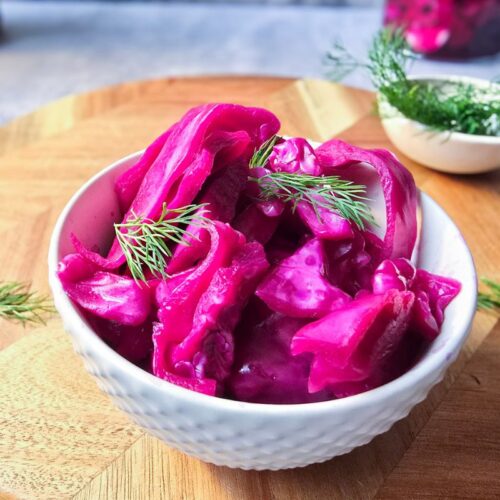
Pink sauerkraut (naturally fermented)

Crunchy chunks of red cabbage lacto-fermented in a simple salt brine with garlic, dill and chili. No massaging, just a jar and about a week on the counter turn into a tangy, probiotic-packed pink sauerkraut.
Made this? A quick star rating above helps other readers find it.
Equipment
- 1 jar approximately 750 ml to 1 l capacity with screw or rubber seal lid
- 1 sharp knife
- 1 funnel (optional)
- 1 scale
- 1 measuring jug (optional, reuse a clean water bottle with known capacity, for example 1 liter)
Ingredients
- 1 medium to large red cabbage
- 25 g salt
- 1 liter water
- 4 large garlic cloves (peeled, no blemishes, sliced)
- a handful dill
- 1 small chili sliced (optional)
Instructions
Prepare the cabbage
- Remove any wilted, dry or bruised outer leaves from the cabbage. You don't need to wash it.
Prepare the garlic, chili and dill
- Peel the garlic and set aside. Make sure your garlic is nice and plump and has no blemishes. You can cut the dark end if you want but it is not necessary.
- Remove any wilted dill strands. Give the dill a good rinse in cold water, shaking any excess water.
- Give the chili a rinse under cold running water. Chop as much chili as you would like, removing the seeds if you don't want it too hot.
Chop the cabbage
- Cut the red cabbage head in half, then quarters and remove the hardcore.
- Cut the cabbage in chunks of roughly 3 cm thickness.
Stuff the fermentation jar
- Start by laying a few garlic cloves, chili and a few strands of dill.
- Continue to stuff the jar with chunks of red cabbage. Don't force them too much, but pack them tight.
- Add the remaining garlic and dill as you fill the jar.
- Wedge a few red cabbage slices at the top to keep everything from rising up.
Prepare the brine
- Add 25 g of salt to one liter of cold water and swirl to dissolve.
- Pour the brine carefully over the veggies until they are fully covered. If you have a fermentation weight, you can add it here to keep things submerged.
Fermentation stage
- Make sure there is no space left in the jar at the top then close the lid loosely. Important: remove the rubber seal to allow gas to escape during fermentation!
- Set the jar aside at room temperature, but not too close to a hot or sunny spot.
- The liquid will become a bright pink and little cloudy from day 2 onward.
Burp the jar daily
- You need to "burp" the brine daily. Use a clean large diameter stainless steel straw if you have one, but can use any plastic drink straws.
- Blow gently to form bubbles in the brine careful not to spill the brine over. This will help with the lacto-fermentation by releasing the gases. You can use a clean spoon to push down instead of blowing through a straw.
- Taste the brine after day 3 and the sauerkraut after day 5, to make sure you are happy with the taste.
- It will take around 7 days to achieve a pleasant sourness and a slight fizz, depending on the temperature of your kitchen.
How to store
- After 7 days, if you are happy with the level of sourness, store the jar in the fridge.
- Every time you serve it, take some sauerkraut out of the brine with clean utensils and place the jar back in the fridge immediately.
Video
Notes
You can also slice the red cabbage as you stuff the jar.
That way you only slice what you need to fit in the empty spaces. You may not use all of it, use the leftovers in a stir fry or a salad later!
Remove the rubber seal to allow gas to escape during fermentation.
You may wonder what type of salt to use, but I found that it really doesn't matter if you are using Kosher salt or pink Himalayan salt.
I just use ordinary table salt (just make sure there are no other ingredients apart from salt) and it works like a treat! 🫶
If you use rock salt, you may need to stir the brine with a clean tablespoon or chopstick until is well dissolved.
[convertkit form=5652602]
Nutrition
Calories: 5kcalCarbohydrates: 1gProtein: 0.2gFat: 0.03gSaturated Fat: 0.004gPolyunsaturated Fat: 0.02gMonounsaturated Fat: 0.001gSodium: 1218mgPotassium: 25mgFiber: 0.1gSugar: 0.3gVitamin A: 55IUVitamin C: 9mgCalcium: 8mgIron: 0.1mg
Tried this recipe?Tag me @candyflosslife on Instagram! I'd love to see how your dish turns out ! ✨